
Abu Dhabi’s healthcare ambition is increasingly extending beyond healthcare delivery and conventional pharmaceutical market access.
Recent official initiatives point toward the development of a broader intelligent life sciences ecosystem connecting artificial intelligence, genomic and clinical data, research infrastructure, advanced therapies and regulatory development.
For international pharmaceutical, biotechnology and health-technology companies, this evolution deserves attention.
The opportunity is not simply that Abu Dhabi is investing in healthcare. The more important development is the increasing connection between scientific research, health and genomic data, drug discovery, clinical development, regulation and eventual patient access.
Verified developments and ViaFarma’s strategic interpretation
The dated initiatives and programme details below are drawn from the cited official Department of Health – Abu Dhabi and Emirates Drug Establishment sources. The implications for company strategy are ViaFarma’s professional interpretation and should be tested against the product, evidence, intended use and target UAE pathway.
AI-enabled drug discovery is moving into the ecosystem
On 21 October 2026, the Department of Health – Abu Dhabi and Isomorphic Labs announced a Memorandum of Understanding to collaborate on AI-enabled drug-discovery research and explore innovation frameworks for pre-clinical research.
According to the Department of Health, the collaborators aim to develop a pre-clinical research roadmap for selected AI-enabled discovery projects over a 24-month period, with research conducted within Abu Dhabi’s Trusted Research Environment.
The Department describes the collaboration as part of Abu Dhabi’s intelligent life sciences strategy, connecting population-scale genomic and health data, research infrastructure and regulatory pathways to support the development of new medicines.
Official source: DoH–Isomorphic Labs collaboration, 21 October 2026
This is strategically important for pharmaceutical and biotechnology companies.
AI-enabled drug discovery becomes more relevant when computational capabilities can interact with high-quality clinical and genomic data, research infrastructure and a healthcare ecosystem capable of supporting evidence generation and development.
For companies evaluating the UAE, Abu Dhabi may therefore increasingly warrant consideration not only as a destination for commercial launch, but also as part of a broader research, development and innovation strategy.
This does not mean that participation in research programmes or access to data is automatic. Individual projects remain subject to applicable governance, regulatory, ethical and institutional requirements.
A Trusted Research Environment built around genomic and health data
On 21 October 2026, the Department of Health – Abu Dhabi also announced the launch of its Trusted Research Environment, or TRE.
The platform is designed to enable approved researchers to analyse genomic and health data within a protected environment.
According to the Department, the TRE brings together nearly 950,000 whole genomes from the Emirati Genome Programme with more than 2 billion clinical and claims records.
Approved researchers from academia, healthcare providers, pharmaceutical companies and biotechnology companies may analyse data within secure research workspaces, subject to the applicable governance and approval framework. Importantly, the underlying data remains within the protected environment.
Official source: DoH Trusted Research Environment launch, 21 October 2026
This infrastructure may create relevance for areas including:
- Disease research.
- Precision medicine.
- Drug-discovery research.
- Evidence generation.
- Population-specific research.
- Genomic and biomarker research.
- Development of more personalised approaches to healthcare.
For international life-sciences companies, access to appropriately governed research infrastructure and population-specific genomic and clinical data can influence decisions concerning research collaborations, evidence-generation strategies and long-term market positioning.
However, companies should not interpret the existence of the TRE as automatic access to data. Research activities remain subject to the relevant governance, ethical, regulatory and institutional requirements.
Advanced therapies are becoming a strategic priority
The direction is also visible in advanced therapies.
On 22 October 2026, the Emirates Drug Establishment announced a Memorandum of Understanding with Abu Dhabi Stem Cells Center aimed at strengthening scientific and technical cooperation in advanced-therapy medicinal products.
The initiative forms part of broader efforts to strengthen national capabilities in medical-product regulation, scientific assessment and pharmaceutical innovation.
Official source: EDE MoUs with ADSCC and SEHA, 22 October 2026
Advanced therapies are also reflected in Abu Dhabi’s research priorities. The Department of Health – Abu Dhabi identifies Cell & Gene Therapy among the priority areas for its 2026 Health Research and Innovation Grant.
The listed areas include research involving:
- In-vivo gene therapy.
- CAR-T and CAR-NK approaches.
- Tumour-infiltrating lymphocytes.
- TCR-based therapies.
- Induced pluripotent stem cells.
- Mesenchymal stem cells.
- Exosomes.
- Bone-marrow transplantation.
Official source: DoH–Ma’an 2026 healthcare research and innovation priorities
These developments should not be interpreted as automatic regulatory acceptance, approval or market access for any particular technology or product.
Instead, they demonstrate that advanced therapies are becoming an increasingly visible component of Abu Dhabi’s research and life-sciences agenda.
For developers of cell therapies, gene therapies, biologics and other innovative products, early regulatory strategy becomes particularly important.
Product classification, evidence requirements, manufacturing controls, clinical-development pathways, quality requirements and market-access considerations may differ substantially from those applicable to conventional pharmaceutical products.
Regulation is evolving alongside science
An important element of Abu Dhabi’s direction is that research infrastructure is being developed alongside governance and regulatory frameworks.
The Department of Health maintains policies and frameworks relevant to areas such as:
- Trusted Research Environments.
- Genomics.
- Precision medicine.
- Artificial intelligence in healthcare.
- Bioconvergence.
Official source: Department of Health – Abu Dhabi policy library
This is important for companies assessing emerging technologies. Scientific feasibility alone is not sufficient.
Innovative healthcare products require an appropriate regulatory pathway, evidence strategy, governance framework and eventual route to patient access.
For pharmaceutical and biotechnology companies, regulatory strategy should therefore be considered early rather than after research or commercial decisions have already been made.
Clinical research infrastructure matters
Abu Dhabi also maintains formal structures for healthcare research and clinical studies.
The Department of Health prioritises clinical trials and real-world studies and supports research collaboration involving healthcare providers, industry partners and international research partners.
Its research framework includes areas such as clinical trials, pharmaceutical research, precision medicine, advanced therapies and technology-enabled healthcare research.
Official source: Abu Dhabi Healthcare Research & Innovation Grant
This infrastructure matters because a functioning life-sciences ecosystem requires more than investment announcements.
Companies evaluating a jurisdiction for research or product development need to understand whether appropriate capabilities are available for the specific project, including:
- Research institutions.
- Clinical sites.
- Investigators.
- CRO capabilities.
- Ethical-review mechanisms.
- Data infrastructure.
- Regulatory pathways.
- Evidence-generation capabilities.
Each project should be assessed individually.
What does this mean for international pharma and biotech companies?
For companies considering the UAE, the strategic question is evolving.
Historically, UAE market-entry planning may have focused primarily on: “Can we register the product?”
Registration remains essential. But for innovative pharmaceutical and biotechnology products, the decision framework may now need to be broader.
Companies may increasingly need to consider:
- What is the appropriate UAE regulatory pathway for the product or technology?
- What evidence will be required?
- Could Abu Dhabi provide relevant research, clinical-development or evidence-generation opportunities?
- Are local clinical, scientific or institutional partnerships relevant?
- Does the product require a specialised regulatory strategy because it involves an advanced therapy, novel technology or combination approach?
- What local commercial, distribution and market-access structure will ultimately be required?
- Could localisation, technology transfer or strategic partnership form part of the long-term UAE strategy?
The answer will vary significantly by product. A conventional generic pharmaceutical product and a novel cell or gene therapy should not be approached using the same market-entry model.
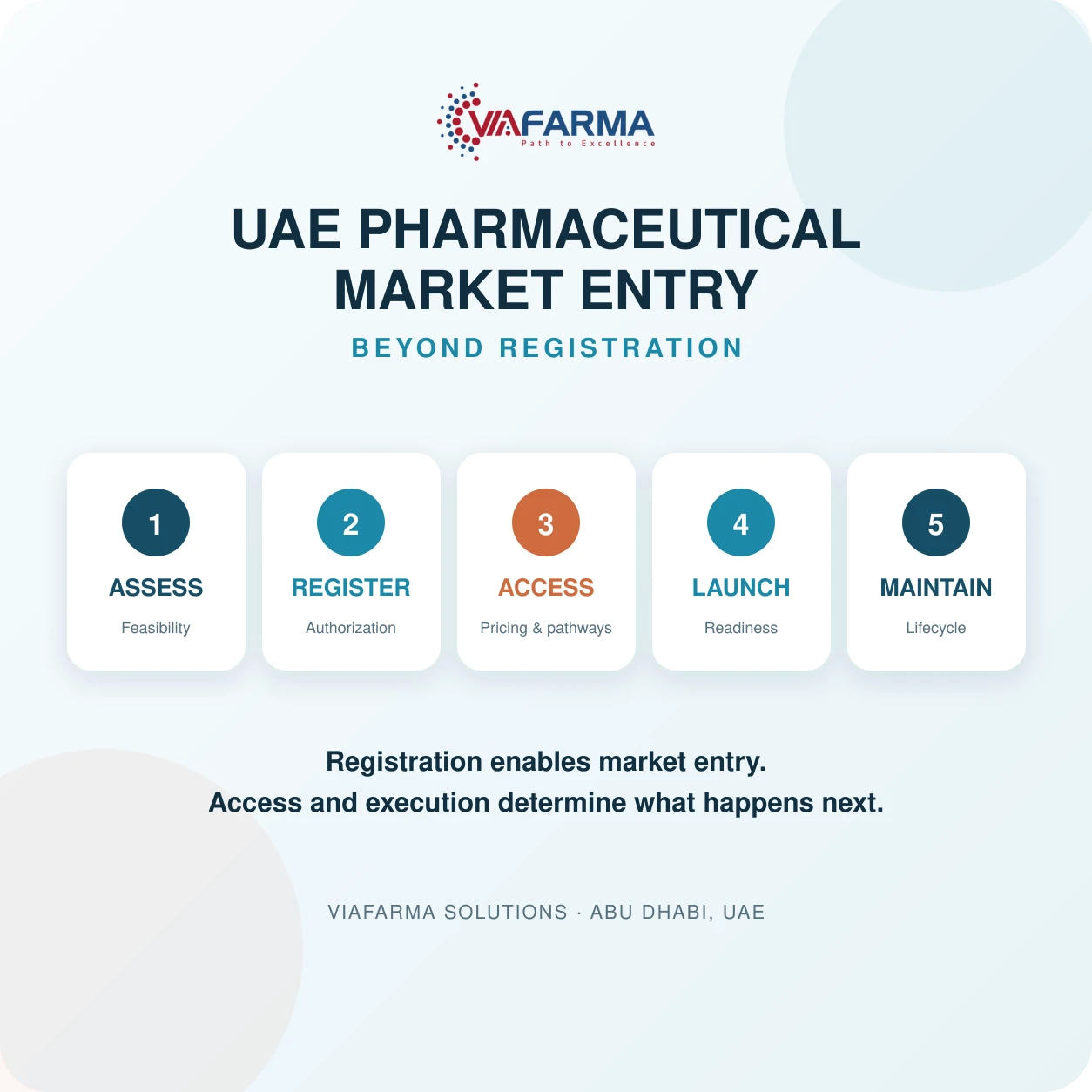
Registration is only one part of UAE market entry
One of the most important implications for international companies is that regulatory approval should not be treated as the entire UAE market-entry strategy.
A complete assessment may need to follow the broader pathway: ASSESS → REGISTER → ACCESS → LAUNCH → MAINTAIN.
Depending on the product, this can include:
- Regulatory classification and pathway assessment.
- Dossier and evidence readiness.
- Manufacturer and manufacturing-site requirements.
- Local representation and distribution structure.
- Clinical or research requirements.
- Pricing considerations.
- Reimbursement and insurance access.
- Coding requirements.
- Pharmacovigilance obligations.
- Local partnerships.
- Technology transfer or localisation opportunities.
- Launch strategy.
- Post-approval regulatory maintenance.
Companies that evaluate these issues before committing significant resources are better positioned to identify regulatory obstacles, commercial limitations and partnership requirements early.
Abu Dhabi is becoming relevant earlier in the product lifecycle
The broader strategic signal is important.
Abu Dhabi is increasingly developing capabilities that extend earlier into the life-sciences lifecycle, where data, research, discovery, clinical development, advanced therapies and regulation intersect.
For pharmaceutical and biotechnology companies, this may create opportunities beyond conventional product distribution. But these opportunities require disciplined assessment.
Scientific attractiveness does not automatically translate into regulatory feasibility. Regulatory feasibility does not automatically translate into market access. And market access does not automatically translate into commercial viability.
Each product therefore requires an individual assessment of:
- Regulatory pathway.
- Evidence requirements.
- Clinical-development requirements where applicable.
- Market potential.
- Reimbursement and access.
- Local operating model.
- Partnership requirements.
- Long-term commercial strategy.
How ViaFarma supports UAE market entry
ViaFarma Solutions supports pharmaceutical, biotechnology, healthcare and medical-technology companies evaluating regulatory and commercial opportunities in the UAE and GCC.
Depending on the project, ViaFarma support may include:
- UAE regulatory pathway assessment.
- Pharmaceutical product registration.
- Regulatory strategy.
- Dossier and eCTD support.
- Market-entry assessment.
- Market-access and commercialisation planning.
- Partner and distributor strategy.
- Bioequivalence Study Support & CRO Access.
- API and raw-material sourcing.
- Pharmacovigilance support.
- Strategic regulatory and business-development advisory.
ViaFarma does not position itself as a laboratory or CRO.
Where specialised research, laboratory or clinical-study capabilities are required, the appropriate qualified or approved service providers should be identified according to the specific project requirements.
Related ViaFarma services
Official sources
- Department of Health – Abu Dhabi — DoH and Isomorphic Labs collaborate to advance AI drug-discovery research (21 October 2026)
- Department of Health – Abu Dhabi — DoH launches Trusted Research Environment to support genomic and health research (21 October 2026)
- Emirates Drug Establishment — EDE signs MoUs with ADSCC and SEHA (22 October 2026)
- Department of Health – Abu Dhabi — Abu Dhabi Healthcare Research & Innovation Grant: 2026 priority areas
- Department of Health – Abu Dhabi — current healthcare policies, including TRE, bioconvergence, precision medicine, genomics and AI