For an international pharmaceutical company, receiving UAE regulatory approval is a major achievement. It confirms that the product has completed the applicable authorization process and creates the legal foundation for market entry. It is not, however, the entire market-entry plan.
Companies that prepare only for registration may later discover unresolved questions about pricing, coding, coverage, procurement, local representation, importation, distribution, launch compliance and post-approval responsibilities. Addressing these questions early helps connect the regulatory pathway to a realistic launch plan.
A connected UAE market-entry journey
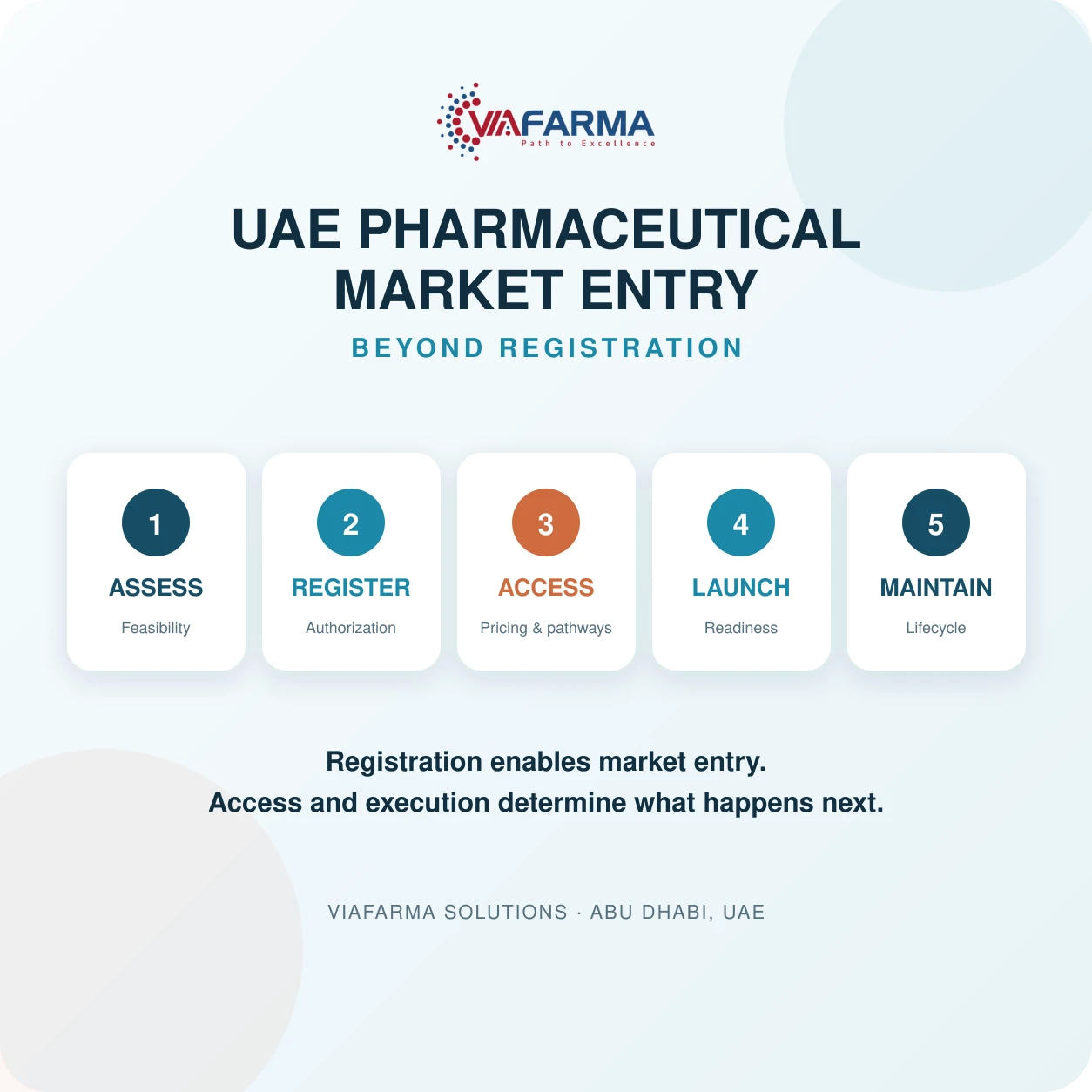
ViaFarma uses a practical five-stage framework: ASSESS → REGISTER → ACCESS → LAUNCH → MAINTAIN.
1. ASSESS — establish feasibility before committing resources
The first step is to understand what the product is, how it is likely to be classified, which authority pathway applies, and whether the available technical and commercial information is sufficient to proceed.
- Product classification and UAE regulatory feasibility.
- Dossier and evidence readiness, including major gaps.
- Manufacturer, site and Marketing Authorization Holder (MAH) considerations.
- Preliminary pricing, access, distribution and import considerations.
- A coordinated regulatory and commercial pathway with realistic next steps.
2. REGISTER — build the authorization pathway correctly
Registration remains a core and potentially complex workstream. The exact requirements depend on classification, product type, manufacturing structure, dossier status and the applicable Emirates Drug Establishment (EDE) process.
- Regulatory strategy and submission planning.
- MAH, manufacturer and manufacturing-site requirements.
- Technical dossier preparation, eCTD documentation and gap resolution.
- Artwork, labelling and product-information compliance.
- Authority queries, samples, testing and registration follow-up where applicable.
The objective is not merely to submit documents. It is to establish a defensible authorization pathway that supports the product’s intended UAE use and later lifecycle obligations.
3. ACCESS — plan how approval connects to use
A registered product may still face practical barriers before it reaches patients, healthcare professionals or purchasing institutions. Access planning should therefore run alongside registration rather than starting only after approval.
- Pricing-pathway requirements and timing.
- Coding, coverage and insurer-readiness considerations.
- Hospital, formulary, tender or procurement pathways where relevant.
- Value communication and evidence needs appropriate to the product.
- Distributor, local partner and market-entry structure.
Regulatory approval does not itself guarantee reimbursement, procurement, prescribing, stocking or sales. Each product requires an access plan proportionate to its category, channel and intended customers.
4. LAUNCH — convert readiness into compliant execution
Launch readiness connects the approved product with the people and processes needed to place it on the market. This includes operational coordination as well as regulatory control.
- Import and supply-chain readiness.
- Distributor and local-partner coordination.
- Launch sequencing linked to registration, pricing and access milestones.
- Promotional, advertising and scientific-communication compliance where applicable.
- Commercial and business-development support within the agreed scope.
5. MAINTAIN — protect the product throughout its UAE lifecycle
Market entry creates continuing responsibilities. Companies should define ownership, timelines and procedures for maintaining the authorization and responding to safety, quality, supply and regulatory changes.
- Pharmacovigilance and post-market obligations.
- Variations, renewals and registered-detail maintenance.
- Artwork, labelling and product-information changes.
- Ongoing regulatory intelligence and compliance.
- Lifecycle and market-access follow-up.
Why planning beyond approval matters
The strongest UAE market-entry plans connect regulatory, access and commercial decisions from the beginning. A change in classification can affect the dossier and timeline. The registration route can influence local representation and import arrangements. Pricing and evidence needs can affect launch sequencing. Post-approval obligations can require local systems and responsible persons before commercialization.
Registration enables market entry. Access and execution determine what happens next. This is a strategic principle—not a promise of reimbursement or commercial success.
How ViaFarma Solutions supports the journey
ViaFarma Solutions supports pharmaceutical and healthcare companies across the UAE product lifecycle, from initial feasibility and EDE registration through access preparation, partner and distributor coordination, launch readiness and post-approval compliance.
- Product classification, pathway and regulatory-readiness assessment.
- EDE registration, dossier, eCTD, artwork and labelling support.
- Pricing, coding, coverage and procurement-pathway considerations.
- Local partner, distributor, import and launch-readiness coordination.
- Pharmacovigilance, variations, renewals and lifecycle support.
The appropriate scope depends on the product, its current approvals, available evidence, target channel and UAE business model. Where specialist input is required beyond ViaFarma’s established scope, suitable expertise may be coordinated with the client.
Related ViaFarma services
Official sources
- Emirates Drug Establishment — Marketing Authorization for a Drug or Biopharmaceutical Product
- Emirates Drug Establishment — Medical Product Pricing Certificate
- Department of Health – Abu Dhabi — Health Technology Assessment Guidelines
- Emirates Drug Establishment — Good Pharmacovigilance Practices Guideline
Frequently asked questions
Is UAE pharmaceutical registration enough to launch a product?
Registration is an essential milestone, but launch also depends on pricing and access readiness, import and distribution arrangements, operational execution, and ongoing post-approval compliance.
When should UAE market-access planning begin?
It should begin during early feasibility and regulatory planning so that pricing, coding, coverage, procurement and evidence considerations can be aligned with the registration and launch timeline.
Does regulatory approval guarantee insurance coverage or commercial uptake?
No. Regulatory approval permits the product to proceed within the applicable legal framework, but it does not guarantee reimbursement, procurement, prescribing, stocking or sales.
What should a manufacturer assess before entering the UAE?
The assessment should cover classification, regulatory feasibility, dossier readiness, MAH and site requirements, pricing and access considerations, distribution and import structure, launch readiness and lifecycle obligations.